Anniversaries invite reflection, and we've been sitting with a question: what has actually shaped how we work? Not only the neat project outcomes or milestone achievements; but the deeper shifts in how we understand our role as an institution that conducts research, evaluation, and technical assistance at the intersection of social-environmental change and climate justice.
The truth is, our most significant learning has come from staying with the troubles and in conversation; with communities navigating complex environmental and political realities, with partners generating, implementing, and revisiting ideas and practices in difficult contexts, and with each other as we grapple with what it means to do this work responsibly. Here's some lessons that emerged:
Research: Who Gets to Know? Who Gets to Say?
"Participatory research redistributes power --over defining problems, imagining solutions, and navigating the social-political terrains."
Our recent work on research projects like “Guardians Under Pressure: Southeast Asian Environmental Defenders” and “Empowering Communities: A People-Centered Energy Transition for Socio-Economic Resilience” has fundamentally shifted how we understand research practice. We've been experimenting with feminist participatory action research, where selected community members and interlocutors aren't just consulted; they also become co-researchers. Dala researchers take on more facilitative roles, providing methodological training while research interlocutors lead investigations into their lived realities. This approach challenges assumptions about where expertise lives and who has the authority to produce knowledge about social and environmental change.
It's been challenging, though. Doing this well requires sustained, in-person engagement that project budgets and time frames don't always support. And despite preparing multi-modal methods—visual tools, verbal narratives, diverse formats—research activities remain difficult to access for some marginalized groups. We've also noticed different patterns of engagement and articulation across genders, generations, and other social dimensions. These differences remind us that knowledge within groups and communities is never monolithic. There are contestations about what matters, whose interpretation of problems should guide action, and what change should look like. This complexity doesn't go away through better methods—it demands we wrestle with what participatory research actually produces: whose analysis gets amplified in policy spaces, which solutions gain traction with decision makers, and how we hold space for disagreement without paralyzing the possibility for collective action.
What This Means: Moving away from expert-driven, top-down knowledge production requires more than time and resources. It means staying with the messy politics of representation and being honest about the power we still hold in translating contested community realities into research that travels.
Evaluation: Learning With Complexity
"Evaluation works best when learning is shared, not extracted, and when we resist the pressure to simplify what refuses to be simple."
Evaluation often comes with an expectation of closure: clear findings, neat lessons, defensible conclusions. Yet over eight years, our most important shift has been moving from evaluation as measurement to evaluation as meaning-making — especially in contexts where linear results logic breaks down and lived realities defy tidy categorization. In practice, this means resisting pressure to simplify non-linear change into narratives of success or failure. Many programmes we evaluate unfold within shifting political, socio-ecological, and institutional realities, where outcomes emerge unevenly and sometimes contradict original intentions. Rather than forcing coherence, we've learned to co-interpret findings with partners, implementers, and communities — surfacing tangled stories about power, equity, and environment alongside trends in data.
Nevertheless, some tensions remain: reconciling donor expectations for definitive outcomes with the messy unfolding of social-environmental transformation; balancing methodological rigor with responsiveness to stakeholders' diverse priorities; and wrestling with our own positionality in shaping what becomes visible and valuable. Navigating this has reshaped our practice: prioritizing contribution over attribution, sense-making over scoring, learning over judgment.
What This Means: Evaluation is an ongoing practice of attentiveness that values humility, relational accountability, and the discipline of not rushing to conclusions when the work demands we stay with complexity; to center diverse voices in sense-making, and to recognize that the questions we ask shape the answers the world hears.
Technical Assistance: Beyond Delivery toward Shared Ownership
"Supporting decisions means working within power, priorities, and constraint.”
Technical Assistance (TA) has been a significant form of support provided by Dala, accounting for 30 projects (37.5%) out of a total of 80 recorded projects. This reflects partners’ needs for support in addressing practical questions directly related to decision-making and specific implementation. In recent years, these needs have predominantly come from government partners, particularly where political and technocratic processes intersect across energy, land use, climate finance, and forestry.
TA work situated at this intersection of complex issues and technical considerations is highly context-dependent, requiring sensitivity to power relations and political dynamics, as well as continuous adaptation in approach. Without sustained dialogue, needs risk being oversimplified, weakening relevance. What emerges instead is a more reciprocal relationship: TA becomes a space of co-creation, mutual learning, and constructive influence rather than a linear consultant–client exchange.
One of the strongest lessons has been the importance of humility. Teams often enter with clear frameworks, tools, and timelines, assuming that good design will naturally lead to results. In practice, however, realities on the ground are rarely—if ever—that straightforward. Decisions are shaped by political considerations, internal priorities, and very real constraints of time and capacity. Such conditions require TA to remain adaptive, open to correction, and committed to collaboration, rather than assuming superior knowledge.
What This Means: We therefore recognize that TA success cannot be measured solely by analytical rigor or technical credibility, but also by acceptance, trust, and practical value for partners. TA therefore requires a balance of technical and non-technical capacities—from relationship-building and political awareness to managing expectations that are often in flux.
Operations & Technology: What Our Systems Say About Us
“The infrastructure behind our operations doesn’t just enable the work -- it shows what we truly value.”
Working within our systems has taught us that infrastructure we build expresses what we believe about fairness, trust, and responsibility. We believe that the systems we build – our ‘infrastructure’ – aren’t just tools, they are expressions of how we value one another. In our HR practices, we strive to create a level playing field where skills are the focus and growth is accessible to all. We use structured processed not to control, but to provide the transparency needed for a culture of mutual respect. We are constantly learning and refining these policies to ensure they truly protect our internal & external stakeholders from non-constructive bias.
Our IT journey, particularly the migration from big tech to open source workspace, revealed that values-driven choices require practical balance. Choosing tools aligned with our principles sometimes meant adapting workflows and investing in learning, but it also strengthened ownership and intentional use of technology. Finance revealed another layer: accuracy, timeliness, and transparency are central to how we value people’s work. Clear documentation, visible processes, and accountable reporting help people at Dala understand how resources are managed, building trust and shared responsibility.
We treat our system as an ongoing stewardship: sustaining what is effective, strengthening where needed, and ensuring it continues to reflect our values in practice. In this way, our systems remain dependable while evolving thoughtfully — supporting daily work with consistency, accountability, and care.
What This Means: Our value is not defined by statements only. We build it into the systems that shape our daily work. And maintaining those systems is an ongoing act of learning, adjustment, and commitment to our values.
Governance: Who Decides and How Do We Decide?
"Sociocracy gave us better questions, not always easier answers."
In the last year, our shift from action-circle structure to domain and department circles has changed how decisions flow through Dala. What began as an experiment in sociocracy has evolved into a navigation exercise: sorting overlaps, clarifying boundaries, and learning whose voice matters where. Some important question persists: how do we allocate resources considering the different aims and domains across circles? How do we decide how and who to hire to be located in which circle? How do we balance the new structure with the flexibility our work demands?
But … governance work frequently competes with project deadlines for bandwidth. Some circles meet easily, others struggle to find time. Communication gaps mean decisions made in one space don’t always reach others who need to know. We’ve adopted provisional solutions, but all the workarounds only acknowledge that perfect systems cannot be designed in advance; they emerge through practice. What’s becoming clear is that structure alone does not solve coordination problems. Whether circles are merged or separate, whether budgets are pooled or split, the underlying challenge remains: how do we maintain coherent institutional direction while honoring the autonomy of different work domains?
What this means: Distributed governance requires more than new organizational charts and meeting schedules. It means accepting messiness as circles find their rhythm, being explicit about trade-offs between efficiency and autonomy, and staying honest about coordination needs override structural ideals. The question (when our circles are not always perfectly defined) is whether they are improving as we learn, and at the same time help us work more effectively together.
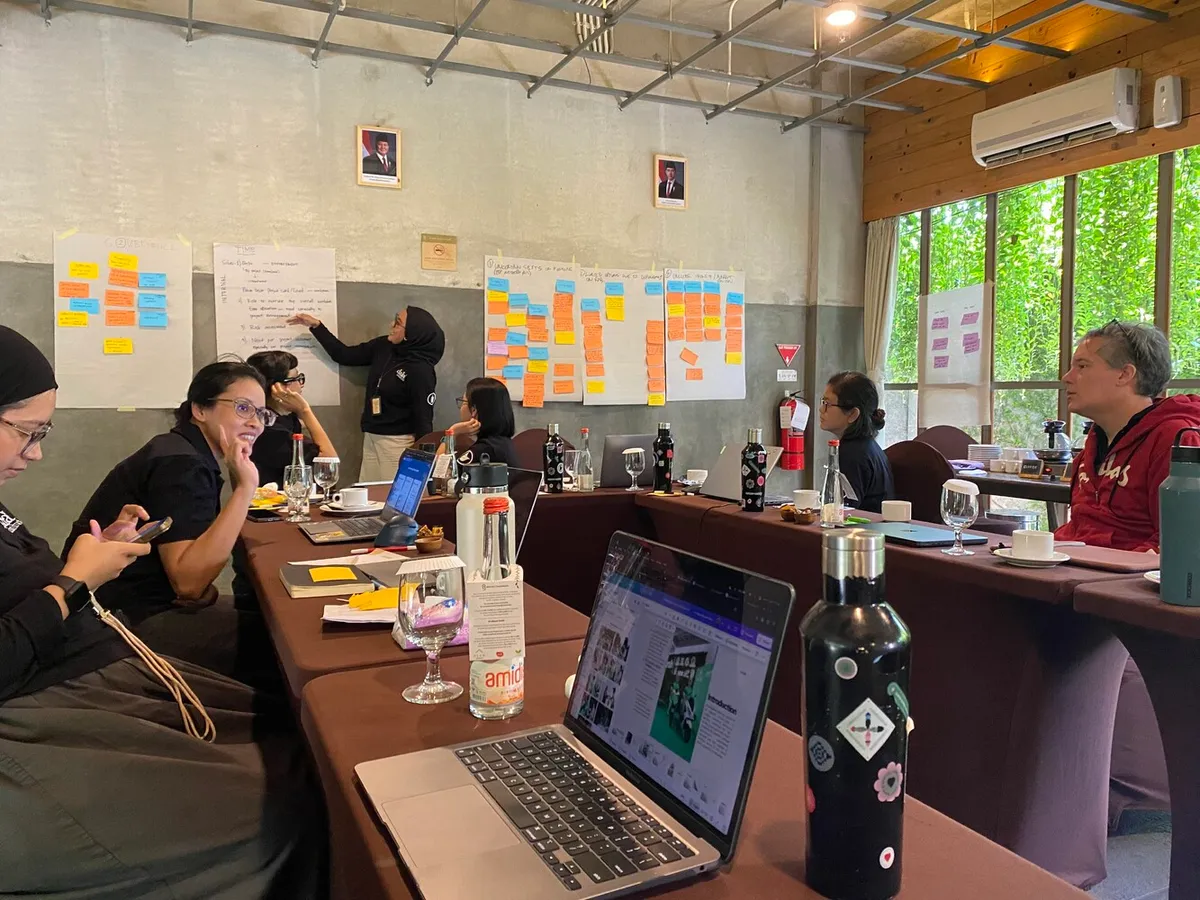
These aren't lessons we've mastered. They're ongoing questions we carry into the work. Working at the intersection of social-environmental change and climate justice doesn't always offer clean answers or perfect methodologies. What it demands is staying present to complexity, remaining accountable to those most affected by socioecological and political crises, and being honest about both the power and limitations of research, evaluation, and technical assistance. We're learning that good work isn't about having it all figured out. It's about staying with the troubles and in conversations, sitting with discomfort, and staying reflexive—attending to shifting power dynamics, questioning our own positioning, and making strategic choices about when and how to act based on careful reading of what each context requires.
What questions is your work asking you to sit with? We'd welcome the conversation :-)
Comments
No comments yet. Be the first to respond.
Enter your email and we will send a sign-in link so you can comment.