
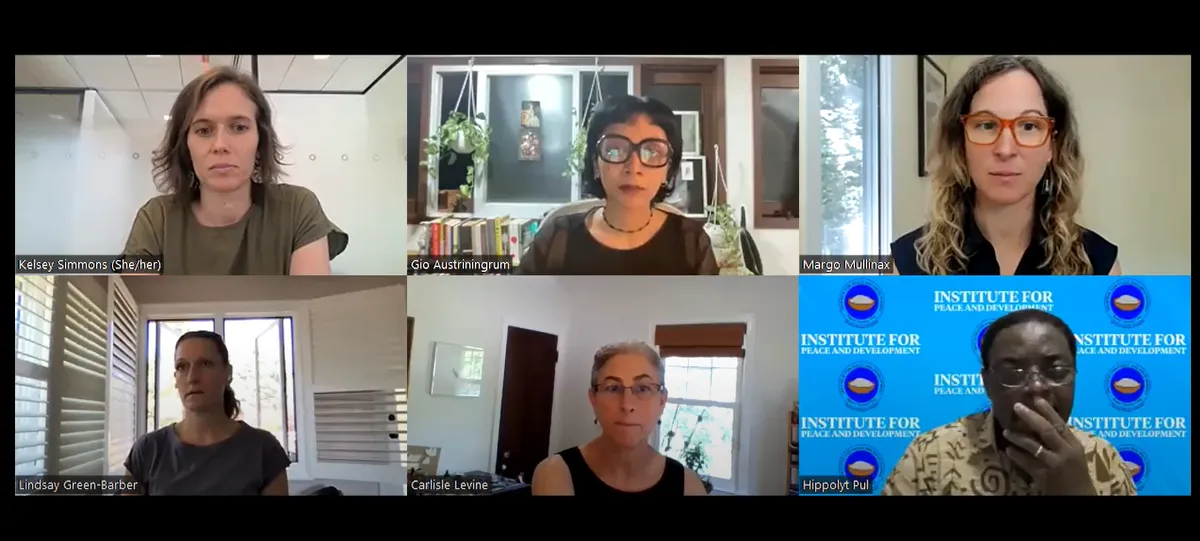
The Dala Institute’s Giovanni Dessy Austriningrum recently spoke at a webinar focused on promoting equity in evaluation contracts hosted by the Center for Evaluation Innovation, BLE Solutions, and Institute for Peace and Development.
We learned of a document published in October, 2023 called “On Equity in Contracting with Small and Solo Local Evaluation Firms: An Open Letter to Funders“ that makes some great points. We realise that at Dala we have been quite effective at bidding against large firms based in the Global North, and yet, much of this open letter rings true to us. The open letter breaks down procurement and contracting issues, providing a practical, and realistic list of things that clients can do to be more inclusive of firms in the Global South and smaller firms and/or solo evaluators.
Here are some of our reflections on the procurement process:
Transparency and Clarity
- Make procurement processes authentic. We know that sometimes clients have a preferred partner in mind. If this is the case, please just be honest and state that in the call for proposals or change procurement policies to allow for this in specific cases. That is the only way clients can be honest in procurement.
- Dual stages of document submissions save everyone's time. As a small enterprise, time is at a premium for us. We often pass on opportunities just because it is a shot in the dark and requires a lengthy proposal. A chance to introduce ourselves to advance a conversation results in a time saver for everyone, and leads toward a more iterative procurement process and ultimately a better match of the client’s needs and the firms’ offerings.
- Give the time to produce a quality proposal. Rarely can we produce a 20-page proposal in a week that demonstrates knowledge of context and subject matter. As a small firm, we can’t drop everything for a proposal, and we can’t start the project yesterday. With a bit of time to pull things together, we are confident we can put our best foot forward to show a client what we can do. We also assume that calls for proposals with a short trigger already have a candidate in mind (see 1 above).
- Our favourite process is one in which the proposal is a start of a conversation. Our job is to convince clients that we are competent to do what they need, but we are also qualified in these spaces and rooted in the Global South, and can co-build the details of the terms of reference by using our knowledge of the spaces, bringing clients closer to what they need.
- Transparency of proposal scoring or considerations is more fair for everyone (even if qualitatively). That way, we can be as convincing as we can for each scoring category.
- We are often stuck with either highly detailed and prescriptive ToRs or very vague ones. There is a sweet spot in which clients can tell us what they need accomplished and we can tell the client how we will accomplish it and how long it will take.
- In the best-case scenario, a client asks us, “We want to know about X, what can you do to fill that need?” This allows us to propose broadly how to answer the question in the contexts we know.
Value Alignment
- The procurement process is as much about us liking the client as the client liking us. We are quite selective about whom we work with and want to get to know the client as well. Information that can help us understand the client’s role in the world is also very influential in our deciding whether or not to bid.
- If clients value an orientation towards decolonisation, then give points and/or consideration for representation of a firm and team from the Global South. We don’t mind losing a bid, but it stings when our proposal loses to a firm from the Global North when the assignment is in our own backyard. This means more carbon emissions, more knowledge capture, less contextual understanding, and profits flowing back to colonising countries. We engage in networks in our own country every day and are always sharing knowledge. that continued benefit is lost when the knowledge gained goes abroad and does not circulate back.
- If clients value intersectionality, then give points and/or consideration for representation of a firm and team that reflect those values. We pivot on intersectionality to challenge and tackle overlapping reinforcers of inequalities for a justice-oriented transformation. Most of our staff are women and all of us have a voice in decision-making. If clients want to work with a group like that, then it needs to be part of the selection process.
Questioning Biased Assumptions
- Take a risk on bidders whose name is not a brand name. We don’t have much of a marketing budget and we aren’t based in the Global North so it is much more expensive for us to go to conferences and workshops there. We hope clients can avoid the bias towards established Western brands that they know, and take a chance on organisations rooted in the Global South that will give them everything they’ve got. This is not a call to compromise quality, but a call to adjust perceptions of quality in organisations that are not recognised brands. We are happy to show clients our quality to those open to listening.
- Consider that not all firms are structured in a hierarchy, but can still have accountability and get the job done. When we are assessed based on organisational structures that we believe we have evolved beyond, it signals a lack of ability to depart from hegemonic notions of organisational development. We love accountability, but ask clients to see it through a lens of something other than a conventional Eurocentric hierarchical management model.
- There aren’t that many funders still requiring that the lead firm has to be from their own country, but they still exist- especially the research funders. We don’t think we have to explain how this perpetuates colonial logics. We have the same expertise, qualifications, systems, and accountability mechanisms.
- We suggest that the people who have 10-page CVs have likely benefited from a fair bit of privilege. At Dala, we have been fortunate to attract a lot of people with fancy CVs, but it also makes it harder for us to give opportunities to early-career researchers and/or people with valuable experience that cannot be reflected in the length or fanciness of a CV. We also know a lot of other organisations who are excellent but can’t compete in this space.
- The choice of an organisation to form as a profit or not-for-profit involved a lot of highly contextual considerations. Please don’t assume that somehow a for-profit firm is any less committed to virtuous pursuits or that somehow funds will be distributed any differently… This is an arbitrary set of assumptions that is not grounded in local realities. Look at the organisation’s mission, purpose, and values and then make an assessment of how well it aligns with the client rather than an arbitrary distinction on legal formation. For Dala, we feel we can be the most independent, and most efficient being legally registered as a for-profit company due to local realities.
- Be open to the work of contracted firms being conducted in non-colonial languages. Service delivery partners can always get a translation at the end if clients don’t have someone on staff who speaks this language. The requirement to work in colonial languages means that our hiring also has to require proficiency in these languages, which means that we only hire people who have been in a position of privilege to learn these languages.
Budgets and Payments
- We know clients have budgets. Just tell us what it is and we can tell the client what we can do with it. We value transparency and prefer to skip the dance of guessing how much the client wants to spend on this. We much prefer that clients are transparent on this and we can work backwards by giving clients value for money with how we can address the goal of the assignment with the resources the client has.
- Prescriptive overheads are suffocating. We really don’t understand applying a grant-based financing model to consultancy. For consultancy, we offer a service to the client. We propose the service, deliverables and price. Really, how we use that money is irrelevant to the client. Our job is to convince the client that we are delivering high-quality results for a reasonable price. We have even seen funder requirements that dictate overheads for organisations in the Global North at double the rate of the Global South (as a percentage of costs). We cannot even fathom the logic of that and consider it nothing short of colonial mentality.
- Please don’t tell us how many days things will take AND what our rates should be. Both of these are really our business and we can talk about the total cost with the client, but we don’t think the client should be dictating this to us.
- Please don’t expect that someone with the same qualifications and capabilities in the Global South should bill out at less than someone from the Global North. Yes, we can usually do things cheaper than our competitors because we save on long-haul flights and fancy per diems, but our day rates are at market because our people are excellent and qualified.
- Small firms can’t bridge the gap between payments for deliverables. Most of our clients are great with this and are happy to give us a solid first advance to get us started.
—
Article by Rodd Myers an Giovanni Dessy Austriningrum
Watch the webinar here:
Subscribe to Dala Dispatch Newsletter and make sure to follow our Linkedin and Instagram account (@dalainstitute) for insightful analyses and a glimpse into our work, as we integrate the social-environmental dimensions and amplify diverse Global South voices, fostering fairness and equity!
Comments
No comments yet. Be the first to respond.
Enter your email and we will send a sign-in link so you can comment.