In late June, a team from Dala traveled to Barcelona for the POLLEN Conference 2026, the biennial gathering of the Political Ecology Network. This year's theme, "Diverse Origins, Multiple Futures: The Stories of Political Ecology," drew over 850 participants across 134 panels. We were among them.
POLLEN was our first time presenting as a research team drawing from shared fieldwork rather than as individual scholars shopping for feedback on separate projects. For me, it was the first academic conference of my life—and I was presenting. For Giovanni Dessy Austriningrum, it was her first international academic gathering, so she tried to attend as many panels as possible and to ask questions and engage at every panel she could.
Our panel, 'Global Climate Change Solutions' and Shrinking Civic Space in Southeast Asia, was convened by Rodd Myers (Dala Institute) and Yustina Octifanny (National University Singapore), with Mary Menton (Heriot-Watt University) as discussant. It featured presentations from Dala Institute's Rahayu Harjanthi, Giovanni Dessy Austriningrum, and Vilona Stevanny (me), alongside Aung Kyaw Thein (RCSD, Chiang Mai University, Thailand), Yustina Octifanny (National University Singapore), and Efenita May Taqueban (Legal Resource Centre, Philippines).
The presentations drew from three Southeast Asian countries — Indonesia, the Philippines, and Thailand — examining how the global rhetoric of climate solutions and "just transition" is being used to legitimize familiar patterns of resource extraction, and how states and corporations respond to resistance by shrinking the spaces in which communities can speak, organize, and defend their territories (For the full panel abstract and presentations, see here. ) As far as we could tell, it was one of the very few panels at the entire conference to centre Southeast Asia.
Political ecology is a field built on questions of power, marginality, and uneven development. And yet the conference's gravitational pull — in terms of geography, attendance, and attention — still tilted heavily toward certain regions and certain names. Panels featuring well-known scholars in the same timeslot drew larger crowds. For us, being present in these spaces is itself a privilege that not many scholars (especially those with limited resources) could not experience. Amidst those contexts, we as a panel are offering a form of contribution, as we bring regional South East Asia perspectives that are otherwise underrepresented.
What did feel distinctive about our panel was also how it held together. Because most presenters came from the same project: Guardians Under Pressure, our two-year FPAR study on environmental defenders and civic space, the presentations had a continuity that Vilo described as flowing together "as one whole story, even with presenters from outside the project". This feels different than panels which are assembled from loosely related abstracts submitted by presenters who don’t necessarily know each other. When you present from shared fieldwork, the panel becomes more than a collection of individual papers. It becomes a collective argument, but at the same time we also engaged with each other’s arguments across similar contexts. That coherence and conversations, we think, is one of the things that made the session work, and it's something we want to carry forward.
We also learned from the limits. With more speakers than most panels, we ran short on Q&A time, which several of us felt as a real loss, since the live engagement is precisely what makes conferencing worth doing. Gio also noted that the panel title could have been more specific and provocative: POLLEN audiences are deep in political ecology, and the question a potential attendee is asking is what is this panel offering that I don't yet know? These are practical lessons, and we're taking them seriously for next time.
What We Brought Home
With 134 panels running in parallel, no one could see everything. We spread out across sessions and compared notes afterwards. The intellectual range was vast — and uneven. Some are leaning more towards theoretical and more abstract argument, while others are rich on empirical grounding. Some panels did gave us ideas that are still leaving impressions and working on us months later.
The plenary on democracy, capitalism, and authoritarianism was one of those. Farhana Sultana's plenary presentation on Bangladesh examined how a gen-Z-led protest movement that toppled a government still left the structures of oligarchy largely intact. It crystallized a question that several of us kept circling back to: after decades of well-intentioned social movements and generations of trying in many Global South contexts, many attempts of resistance has still not produced transformative structural change. What kinds of movements and resistance would? This is not an abstract question for us. It connects directly to the communities we work with in Southeast Asia, where resistance is ongoing but structural and systemic change remains elusive.
A panel on ecosocialist transformation pushed this further, arguing that social forces from below must not only resist but actively replace capitalist means of social reproduction, i.e. building working-class-led supply chains, self-reliance, and delinking from extractive systems. When Gio asked about what transition pathways look like in the Global South, where survival is precarious under regimes of cheap labor and cheap nature, the panelists were honest: there are no singular pathways amidst geographical differences. It was the kind of candid non-answer that opens more thinking.
And a panel on infrastructures of resistance shifted something in Vilo's thinking about her own work. One presenter reframed blockades not as things that stop circulation, but as things that reorganize it; creating new forms of connection and knowledge rather than simply halting existing ones. It prompted her to reconsider whether the practices she had been studying in her paper on social movements might themselves be understood as infrastructures of resistance, not just expressions of it.
These intellectual takeaways matter to us not just as ideas, but because they connect to the research we are actively doing. The questions about social movements and resistance, about transition pathways in the Global South, about what it means to build alternatives rather than only oppose what exists — these are live questions in our work, and POLLEN gave us a way, an avenue, and fellow researchers to think with.
Looking Forward
We left Barcelona with new ideas, new connections, and a few lingering debates that are still unresolved. We also came away with a clearer view of what the field still needs to work on. Visa barriers prevented a number of Global South researchers from attending, a concern raised widely on social media during the conference. For a field that studies access and exclusion, this is worth taking seriously.
But more than anything, POLLEN confirmed that showing up as a team, from shared fieldwork, could produce a different kind of contribution. Our panel held together because the research held together. We intend to keep building on that,at future conferences, and in the work itself.
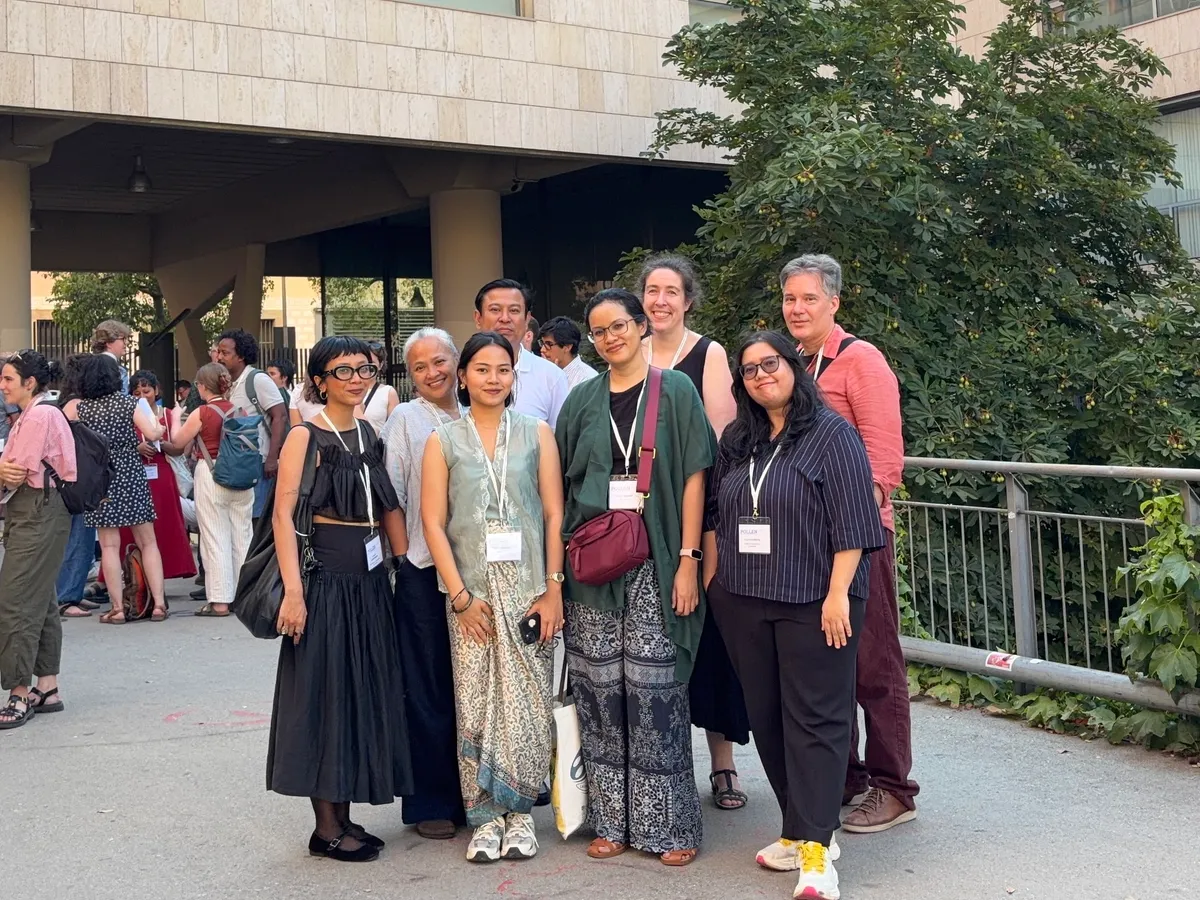
The Dala team at POLLEN 2026: Rahayu Harjanthi, Rodd Myers, Giovanni Dessy Austriningrum, and Vilona Stevanny. The panel was convened by Rodd Myers with Yustina Octifanny (National University Singapore), with Mary Menton (Heriot-Watt University) as discussant, and featured Aung Kyaw Thein (RCSD, Chiang Mai University) and Efenita May Taqueban (LRC, Philippines).
Comments
No comments yet. Be the first to respond.
Enter your email and we will send a sign-in link so you can comment.