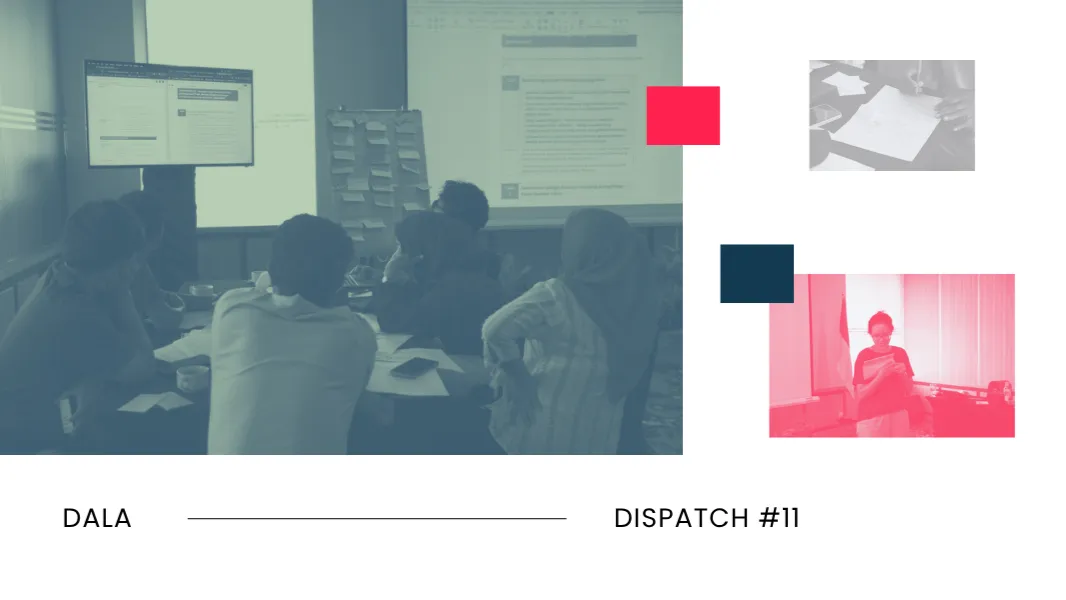
What happens when a research project cannot truly end, even though the project has been administratively closed?
This is a risk that, apparently, one might face when carrying out feminist participatory action research. My team's research project is finished on paper, and the funding has stopped. But unlike other research or evaluation projects that I usually conduct, there is no sense of “relief” as usual. I felt sadness, mixed with deep emotion and joy, witnessing the achievements of our peer researchers.
In my previous writing about a year ago, midway through the project timeline, I reflected a great deal on our process of negotiating with the extractive nature of research. I wrote about our commitment to "give before we ask," about how we redistributed institutional resources to those on the frontlines of environmental struggles, about how we tried—with all our limitations—not to extract knowledge without giving something meaningful in return.
Now, the question is no longer about how we started with those principles. The question is: What remains when the funding ends? What is left behind when the official project closes?
And perhaps more unsettling: Why do I feel a reluctance to draw a conclusion? Why does this feel like a process that must continue, even though the activities are officially over?
The "Guardians Under Pressure" Research
The research project my team and I conducted, where I served as methods lead, was titled "Guardians Under Pressure" (GUP). This study examined environmental defenders and civic space in the context of "false climate solutions" through six case studies in Indonesia, the Philippines, and Thailand. Methodologically, the research used a Feminist Participatory Action Research (FPAR) approach.
FPAR is a research approach that positions those who are typically "research subjects" as co-researchers—peer researchers who are actively involved in the entire process, from formulating research questions and analyzing findings to writing reports. The feminist dimension means we care not only about participation, but also about how intersecting power relations—including gender, generation, class, and access to resources—shape who can produce knowledge and whose knowledge is considered "legitimate." This is not just a method, but a political commitment to redistributing power within the research process.
I led two case studies in Indonesia focused on resistance to nickel mining and geothermal projects in two different locations. In both studies, I worked alongside 12 peer researchers who served as research partners, not merely research subjects.
We started with a commitment: give before we ask. We created a zine as a first act of solidarity, then developed a digital course for research training that they could access whenever they needed it.
The peer researchers then conducted data collection independently. They determined the research questions, chose methods aligned with their communities' oral traditions, and interviewed members of their own communities.
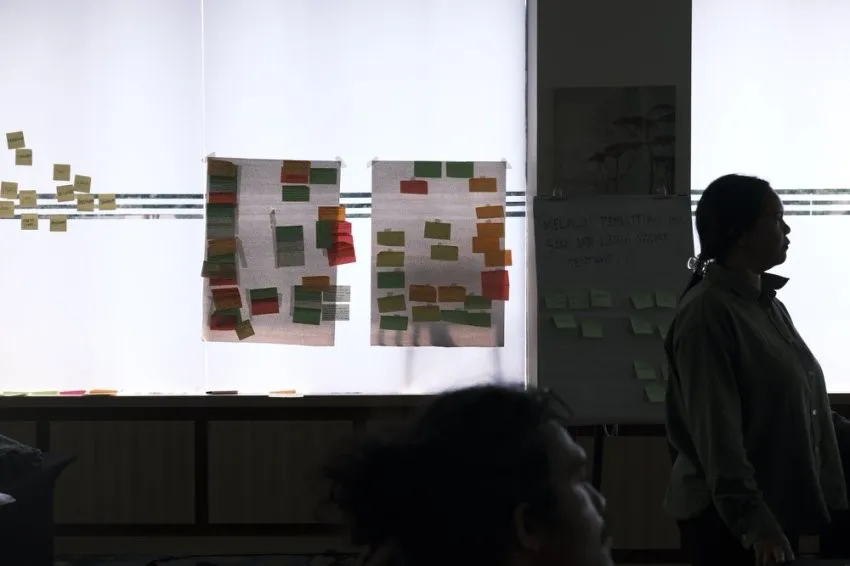
Then came the data analysis workshop in August 2025, the first moment when peer researchers from the two case study sites met and worked together. They exchanged stories, worked, and played together. The two groups quickly formed close bonds. At this workshop, we agreed to create an exhibition as a way to present research findings, serving as an opening for a national workshop organized by our partners at Auriga Nusantara.
The journey continued to Jakarta in November 2025 for the national workshop and exhibition titled "Those Who Sustain What Has Been Wounded: An Anthology of Guardians Amidst the Climate Crisis" at Taman Ismail Marzuki. We chose an exhibition format to challenge boundaries about who has the right to produce knowledge—and how that knowledge is presented. Visitors did not just read reports in the form of exhibition assets, but immersed themselves in artifacts of resistance, objects from the field, photographs, and interview excerpts. There were screenings of community resistance films, discussions on post-mining social recovery, and an interactive wall as a "closing chapter" assembled together with visitors. Civic space was tangibly present before our eyes—a place for dialogue, where peer researchers conveyed the issues they faced.
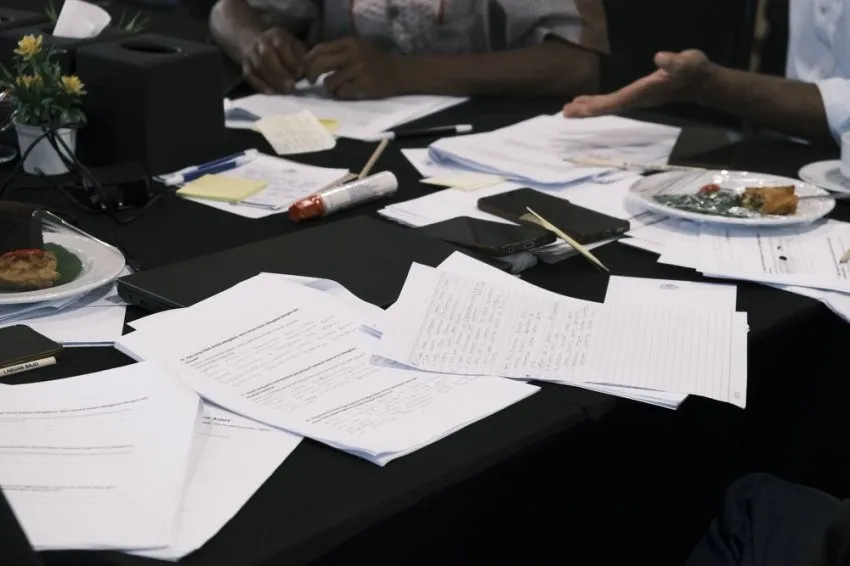
Finally, in April 2026, we held a final four-day workshop. Here they completed their collective reports—one for each case study group. Not individual reports, not reports for us, but collective reports from and for themselves: documentation of the research they designed, the data they collected, the analysis they assembled together—tools for advocacy, community documentation, and evidence that they are legitimate knowledge producers.
Transformation in Participatory Research
Paulo Freire wrote in Pedagogy of the Oppressed that true education is not about "depositing" knowledge from teacher to student. Liberating education is a dialogical process that transforms objects into subjects: from the researched into researchers, from those whose stories are told into storytellers.
When we listened to the reflections of our peer researchers at the end of the workshop, the transformation Freire described was truly happening—in their own words, which were far more powerful.
One peer researcher said:
"Before this activity, I was usually a source of information. It was always students who were the researchers. After this activity, we learned together as researchers."
A simple yet striking sentence. All this time, communities had always been objects of research—those who were interviewed, catalogued, "studied" by outsiders. Knowledge about their lives was extracted, taken away, written in language they did not understand, published in journals they never read.
The fellow researchers were no longer just "informants." They formulated research questions, chose methods aligned with their communities' oral traditions, collected data, and analyzed findings together.
The effects of these activities led the peer researchers to realize the importance of literacy and documentation. They reflected:
"When we used to talk about indigenous research, these were things usually told orally by elders and we just listened without any writing. Now it has become written documentation—this makes me feel it's extraordinary."
Freire spoke about the importance of "naming the world"—that the process of naming reality is the first step toward transforming it. Knowledge about customs, resistance, the impacts of mining and geothermal production does exist in communities, and so far has often only been spoken (verbally), never written down by their own hands.
When the peer researchers began documenting their knowledge—writing about the impacts of geothermal projects on indigenous territories, how women bear double burdens due to nickel mines, the resistance strategies they carry out—they were not just "naming" their reality. They were claiming it. They were asserting that this knowledge belongs to them, and they have the right to define, document, and disseminate it.
Another peer researcher added:
"Through this program, we now understand that ordinary things can become extraordinary in this research."
This is the moment of 'conscientização' that Freire described: critical consciousness that makes people realize they possess valuable knowledge, that their experiences are legitimate data. What is "ordinary"—everyday stories about losing access to forests, contaminated water, intimidation from authorities—becomes "extraordinary" when they realize this is empirical evidence, research findings, knowledge that can be used to fight back.
Questions of Legitimacy
However, with the rise of this critical consciousness, they were confronted with issues that were not entirely within our power to change—issues related to the legitimacy of the knowledge they had built.
Initially, the research activities increased their self-confidence. After conducting the research, they became convinced that their knowledge had a strong methodological foundation, which made them bolder in presenting it to the public. One of the most striking reflections:
"Before, we felt it but we weren't sure. After doing the research, we dared to express our aspirations in public, because we had gained knowledge from the people we met. This is what I consider new—the emergence of courage to express aspirations publicly."
This confidence emerged from 'praxis'—the cycle of action and reflection that Freire described as the core of liberating education. They acted (collecting data, interviewing neighbors, documenting impacts), reflected together (analyzing findings, discussing patterns, writing reports, formulating conclusions), then acted again (using findings for advocacy, campaigns, strengthening resistance).
However, the questions they raised at the end of the workshop also revealed the limitations of our efforts:
"When we look at research from other parties, especially from universities, the university legitimate the research results. Who, then, can legitimize our research?"
Even though they had conducted research based on structured methodology, the academic credentialing system still made them doubt: Will our research be recognized? Or only research from "universities" is considered legitimate?
This is the limit of what we could do through a single project. We could facilitate the process, affirm that their knowledge is valid, but we could not—alone—change the entire system that disqualifies community knowledge. What we can do is continue to affirm that they are true researchers, and that their research challenges the boundaries of knowledge production.
Continued Reflections on Research Extractivism
In my previous writing, I reflected a great deal on research extractivism. Those reflections have not reached a conclusion and still haven’t until today.
During the debrief session of the final workshop, a colleague on our team questioned whether this research "brought more benefit to the peer researchers than to us." At the time, I nodded. Wasn't that what we wanted? Wasn't that proof that we had succeeded in avoiding extraction?
But then I asked myself: Is that true? Or is it just an illusion—a mirror for how conventional research models has been so accustomed to extractive practices?
Let's be honest: we also gained a great deal from this research.
Through this research, we learned about "false climate solutions" by observing how geothermal and nickel mining projects, sold as part of the green energy transition, actually employed the same mechanisms as old extractivism: legal frameworks that bypass local consent, criminalization of resistance, state violence serving capital accumulation. We also witnessed women's roles in environmental defense, while understanding how indigenous governance can serve as a framework for resistance while simultaneously reproducing patriarchal exclusion.
More importantly, we learned to practice FPAR—not from textbooks, but from direct practice. We learned to facilitate without controlling, to accompany without dictating, to adjust timelines and methods when field reality didn't match the plan. This knowledge is now our capital for other projects—capital that cannot be bought or learned without direct engagement.
Of course, there were more measurable outputs: reports, articles, conference presentations, this blog. We received recognition from donors, CSO networks, and academic colleagues. Our institution's name became better known as an organization seriously committed to participatory research. All of this is important, yes, but not the most valuable.
The most valuable thing—perhaps the most difficult to measure—is the intangible. We built meaningful relationships with the peer researchers. We felt the joy of facilitating their work. We enjoyed the process—not just as a professional obligation, but as something that filled our souls. There were moments when we felt, "This is why we do this work." Our team also grew stronger through this process.
So, are we on the losing side in terms of who gets the benefits? Clearly not.
Reciprocity That Liberates Both Sides
And here is where I realized: Perhaps I was asking the wrong question.
The right question is not: "Did we succeed in avoiding extraction?" But: "Our gains—was it the result of genuine dialogue, or of extraction?"
Freire never said that liberating education is a one-way process—where the teacher only gives and receives nothing. Quite the opposite. In problem-posing education, teacher and student both learn. Both are active subjects in the cognitive process.
Freire wrote: "Through dialogue, the teacher-of-the-students and the students-of-the-teacher cease to exist, and a new term emerges: teacher-student with students-teachers." This means both sides teach and learn simultaneously. No one only gives, no one only receives.
If I use this framework, then the fact that we also gained much from this research actually confirms that our methodology tended toward liberating education. It shows that the process that occurred was dialogical, two-way, reciprocal.
The peer researchers learned research methods, data analysis, written documentation. We learned about the reality they experience, their resistance strategies, and how to practice FPAR in contexts of state violence. They gained tools for advocacy. We gained a deeper understanding of false climate solutions. They became more confident speaking in public. We became better facilitators.
This is not extraction. This is reciprocity—an exchange that mutually enriches.
Of course, this exchange is never perfectly equal. Our positions were indeed different from the start: we came with institutional privilege, access to funding, academic legitimacy. This asymmetry did not disappear simply because we used participatory methods.
But positional asymmetry does not mean dialogue is impossible. What matters is: Did we acknowledge that asymmetry? Did we continue striving to redistribute our privilege? Did we respect their knowledge as equal to our academic knowledge?
I think the answer is: We tried. It will never be perfect, but we tried.
Learning from Them, Learning with Them
One of the most important learnings came when a facilitator reflected honestly in our internal debrief: "We didn't work as hard as usual in this workshop. What saved us were the peer researchers—their focus was extraordinary."
This is not an embarrassing admission. It is actually evidence that control had shifted. That the workshop's success no longer depended on how perfectly we facilitated, but on how strongly they had taken ownership of the process.
We were teachers in terms of research methods. But they were teachers in terms of the issues they researched, strategies for surviving amidst repression, how to build solidarity across generations and genders in their communities. We learned from them. They learned from us. And most importantly: we all learned together.
So no, I no longer feel guilty that we also gained much from this research. Quite the opposite: If we had gained nothing, if we had learned nothing, perhaps that would mean dialogue had not occurred. Perhaps that would mean we were only pretending to listen, without truly opening ourselves to be transformed by the process.
Their Research Questions? What About Our Research Questions?
There is another tension I need to acknowledge: The initial research questions designed by our academic team were not fully aligned with the questions that emerged from the community.
We came with questions about how "false climate solutions" affect civic space and environmental defenders. These questions are important. But are they the most important for the community?
The peer researchers were more interested in documenting how geothermal projects damage indigenous governance systems, how knowledge about forests and water that had only been told orally now needed to be written down, how to engage across generations in resistance. They wanted reports that could be used to strengthen indigenous legitimacy before the state and corporations.
The peer researchers wanted to document the concrete impacts of nickel mining on daily life: contaminated water, disappearing fish, conflicts within communities, women bearing multiplied burdens. They wanted empirical evidence for campaigns.
Were our questions answered in their reports? Partially, yes. But not entirely. And that raises an uncomfortable question: What about our accountability to the research questions we proposed in our funding proposal?
Freire is very clear on this: In problem-posing education, the oppressed must define their own problems. If outside researchers determine the questions, that is still banking education—just with more polished packaging.
So we made a choice: We adapted. We let their research questions lead. We acknowledged that the reports they produced might not answer all our donors' questions and it might not fit neatly into the academic framework we had planned. But those reports answered questions that were important to them—and that mattered more.
Fortunately, our donors were flexible enough to understand this and allow project adaptation. Not all donors would be this accommodating. And there lies the structural challenge of practicing FPAR: How do we meet donor expectations that fund research, while still respecting community priorities that may differ?
I don't have a perfect answer to this. What I do know is: Rigidity in outputs and timelines can betray participatory principles. Flexibility is a prerequisite—but not all funding systems allow for it.
When Time and Resources Are Insufficient
Another reflection that emerged from our team: "Capacity building should have been the core of this project. We didn't plan for it thoroughly enough."
We knew FPAR requires more time than conventional research. But still, we underestimated. Capacity building—research training, data analysis mentoring, writing facilitation—should not have been an addition, but the core of the budget and timeline.
Time constraints also meant the reports they produced at the end of the workshop were not yet fully "finished" by academic publication standards—there were still sections that could be deepened, still editing to be done. But this is precisely where I saw something important: We left it to them to continue refining the reports independently, in their own time, in their own way.
This is not a sign of failure in our participatory process. Quite the opposite—it shows that we trusted their strong sense of ownership, their agency, and their ability to continue the process independently. They do not need to wait for us to come again to complete their reports. They can—and will—do it themselves, because these are their reports, not ours.
What Remains
When I wrote in the opening that this research cannot end, I didn't fully understand what I meant by it. But now, after reflecting further, I think this is not about nostalgia or reluctance to let go of a project that consumed three years of my professional life.
It is about something more fundamental: We have already started a process that cannot simply be stopped.
Imagine pushing a heavy wheel. At the beginning, it takes extra effort to get it moving. But once that wheel starts turning, once it reaches a certain momentum, it no longer depends entirely on you to keep moving. It has its own energy.
I feel this research is like that.
In the beginning, we were the ones pushing: making the zine, preparing the training, facilitating the first workshop. But at some point—perhaps at the Bali workshop when they first met and analyzed data together, perhaps at the TIM exhibition when they saw their work displayed and received public response, or perhaps at the final workshop when their focus "saved" the workshop when we were tired—at that point, the momentum had shifted.
They are now the ones pushing that wheel. They are the ones who said they would create a citizen journalism website. They are the ones who decided to continue refining the reports independently. They are the ones already thinking: What should the next research be about? What other documentation do we need to create?
And when that momentum has been created, I cannot—and must not—suddenly stop it just because funding has ended. I cannot say: "Okay, project is over, let’s stop." Because this is no longer our project. This has become their process.
But perhaps more fundamental than momentum is this: We have built relationships that cannot simply revert to what they were before.
Before this project, we were strangers to them. Researchers from Java and Bali who came with proposals and funding.
Now? We know each other in a different way.
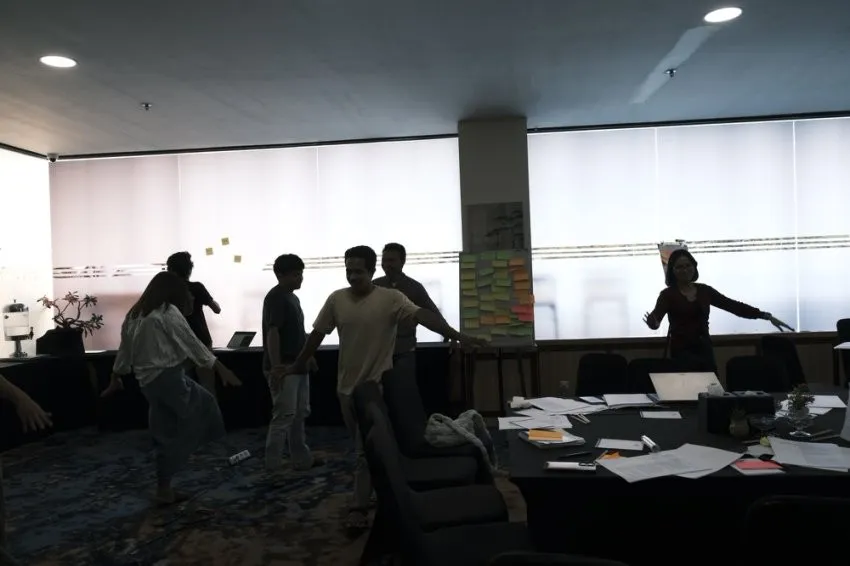
We know how they think, how they analyze the impacts of mining and geothermal projects, how they formulate resistance strategies. They know how we work, how we facilitate, even how we get tired and are not perfect. We have gone through difficult moments together: when data analysis felt hard, when writing reports felt impossible, when we had to decide which data was safe to publish and which had to remain covered.
And we have also gone through joyful moments together: when they first realized that "ordinary things become extraordinary in this research," when they saw their photos and quotes exhibited at TIM, when the reports they wrote began to take shape and they felt proud of their own work.
Relationships built through processes like this cannot simply be "closed" when the project contract ends. This is not like a transactional relationship between consultant and client. It is more like a teacher-student relationship of mutual learning—or more precisely, as Freire described: "teacher-student with students-teacher"—which has no clear endpoint.
Even if we no longer have funds for the next workshop, even if we no longer meet regularly, that relationship remains. They know they can contact us when they need feedback on reports, when they need connections to other CSO networks, when they need someone who can understand the context of their struggle. And we know we can learn from them about how resistance continues, what strategies work, what is happening with the geothermal and nickel mining projects in their locations.
This is not a "long-term commitment" planned from the start or written in a proposal. It is the organic consequence of how we chose to conduct this research: with dialogue, with reciprocity, with respect for them as peers. When you truly practice these principles, the relationships created cannot be reverted to their original state. You cannot suddenly become a "detached objective researcher" again. You are already involved.
So when people ask: "The project is finished, right?", I don't know how to answer.
Administratively, yes. We have submitted the final report to the donor. We have conducted the final workshop. We have accounted for the budget. The project, in the conventional sense, is finished.
But relationally? How do you "finish" a relationship that is still alive? How do you "close" a process that is still moving with its own momentum?
I am reluctant to draw a conclusion because drawing a conclusion implies that something has ended. But what I see is: they will still continue documenting, still continue writing, still continue using the research skills they learned to strengthen their struggle. Resistance against geothermal and nickel mining projects does not stop just because our workshop ended. The repression they face does not stop. Their need to produce knowledge about their own situation does not stop.
And us? We still care. We still want to know what happens to them. We still feel a sense of responsibility—not in a hierarchical "debt of gratitude" sense, but in the sense of connection that emerged from the process we went through together.
Perhaps this is what Freire meant when he spoke of "pedagogy of the oppressed" as something that must be built with, not for them. When you truly build something with others, you cannot simply walk away when the construction phase ends. Because what has been built is not just a product, but also relationships. And relationships continue to live, continue to change, continue to need tending—even without funding, even without a project timeline.
So perhaps this feeling of "reluctance to close" is not a problem that needs to be solved. It is a sign that true participatory research was never meant to have a neat closure. It is a sign that we have succeeded in creating something larger than just a project: a process that has its own life, and relationships that cannot be easily severed.
And I think that should be celebrated, not mourned.
I know that our experience practicing FPAR is not without its challenges and unanswered questions. I want to hear from you—especially those of you who also practice participatory research:
- How do you navigate the tension between donor research questions vs. community priorities?
- How do you ensure reciprocity without falling into extraction?
- What do you do when the "project is over" but the relationships continue?
References
Freire, Paulo. 2019. Pedagogy of the Oppressed. Jakarta: Narasi.
Disclaimer:
- All quotations and information in this writing have received approval from fellow researchers.
- This writing was created with the assistance of Generative AI
Comments
No comments yet. Be the first to respond.
Enter your email and we will send a sign-in link so you can comment.